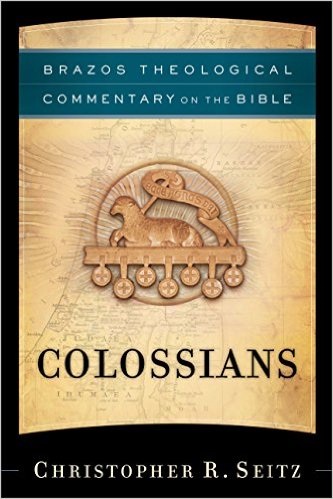
The Vocation of Letter Writing: Christopher Seitz’s Commentary on Colossians

colossiansIn his commentary on Colossians, Christopher Seitz, an Old Testament scholar by trade, makes use of a wide array of ancient and modern Christian interpreters to give an irenic, theologically rich, and textually sensitive reading of Paul’s letter. Seitz’s book is part of the Brazos Theological Commentary on the Bible series, which takes as its premise the idea that “the Nicene tradition, in all its diversity and controversy, provides the proper basis for the interpretation of the Bible as Christian scripture” and that “dogma clarifies rather than obscures” (p.11).

One of the more unique facets of Seitz’s commentary is his canonical approach. He seeks to interpret Colossians in light of both the larger Pauline corpus of which it is a part, as well as the rest of the Old and New Testaments. He acknowledges from the outset that “canonical readings” have come under fire in the past for being “either a genre mistake or a piety masking illegitimate (‘unhistorical’ in our present parlance) interpretation” (p.50). Consequently, Seitz takes time to respond to these criticisms by giving a more in-depth description of what he thinks the term entails: Continue reading

Meal, Word, and Prayer: A Review of Andrew B. McGowan’s “Ancient Christian Worship”

ancient christian worship

First, a slightly provocative—and hopefully not completely unsubstantiated—claim: It seems to me that Andrew McGowan’s Ancient Christian Worship explicitly tells a story and implicitly makes an argument. In each of his colorful and well-written chapters, McGowan takes people on a trek through the different ways in which ancient Christians worshiped. He introduces readers to influential theologians like Augustine, Origen, and John Chrysostom, sharing ample examples from their writings on worship. McGowan also incorporates archeological research and makes use of fascinating early Christian documents like the Didache and the Apostolic Tradition, which give glimpses of how these ancient communities lived out (or sought to live out) their worship practices.

In other words, McGowan intentionally brings together multiple streams of academic research on early Christian worship in order to tell a coherent introductory narrative of how these worship practices originated and developed, while avoiding the tempting pitfalls of over-simplification and excessive generalization. He’s realistic about what is known, unknown, and unfortunately lost to history regarding how these early believers lived. Continue reading

Studies in Galatians Episode I: N.T. Wright on Messiahship

galatians and christian theologyIn the summer of 2012, an assorted group of Pauline specialists and other scholars, including people like John Barclay, Richard Hays, and Beverly Roberts Gaventa, gathered at the University of St. Andrews in Scotland for a conference on Paul’s letter to the Galatians. Out of this gathering came Galatians and Christian Theology, an edited volume of the papers given at the meeting.

These essays are divided into three broad categories: Justification, Gospel, and Ethics (pp.x-xi). Over the next few months, we will be periodically exploring a few of the more interesting essays from each of these sections, even as we continue to dive into other books. For now, let’s turn to our first essay, N.T. Wright’s “Messiahship in Galatians?”

It may strike some as odd, but the importance of Jesus’ messiahship in Galatians has long been minimized by certain parts of Pauline studies. These scholars assume that when Paul uses the word Christos in regards to Jesus, it functions basically as a proper name, emptied of most, if not all, messianic content (p.3). Wright rhetorically takes the view of these writers and asks, “Why… would this letter, warning Paul’s gentile converts against the attractions of Judaism, make use of such an obviously Jewish notion as messiahship?” (p.3). As one might expect, Wright intends to show that Jesus’ messiahship actually occupies a central place in Galatians. Continue reading

The Tales of Jesus: A Review of Stephen Wright’s “Jesus the Storyteller”

jesus the storyteller

In Jesus the StorytellerStephen Wright takes a fresh look at the parables of Jesus, focusing particularly on reading these stories as stories. The first part of the book is a wide-ranging, though necessarily incomplete, survey of how past historical Jesus scholarship has understood the parables.

Since the time of Augustine, these stories of Jesus have often been seen as highly allegorical, making The Good Samaritan, for instance, primarily an allegory for the drama of salvation, with the Samaritan being a symbol for Christ (p.9). Regardless of how spiritualized or overly-imaginative some of these interpretations may have been, they did at least preserve the rich narrative dynamics of these stories, something that was often a casualty of the 19th and 20th century “quests” for the historical Jesus (p.9). Continue reading

The Starting Point of Dogmatic Christology: Ingolf Dalferth’s “Crucified and Resurrected”

crucified and resurrectedIngolf Dalferth’s Crucified and Resurrected strikes me as, at heart, a densely-argued exploration of how to properly orient dogmatic Christology. Originally published as Der auferweckte Gekreuzigte in the early 1990’s, Baker Academic has now opened up Dalferth’s work to the English-speaking world through the careful translating efforts of Jo Bennett.

Dalferth tells readers that “dogmatics describes the inner rationality of the Christian way of life” (p.xxi). Thus, one possible way to consider Crucified and Resurrected is as an examination of the inner rationality of how Christians think through God’s saving activity in Jesus Christ. In regards to this subject, though, where should one start?

This brings us to Dalferth’s central argument. He claims that:

The Christian faith confesses the resurrection of Jesus Christ as an eschatological saving event, simply because it proves that not even death prevents God from maintaining living fellowship with those with whom he wants to be together: it demonstrates unequivocally and irrevocably the life-giving power of God’s desire for fellowship and his love for his creation. (p.28)

The more controversial part of his thesis lies in his insistence that it is the confession of Jesus as crucified and resurrected—and not the incarnation—that must form the primary starting point of Christology. This assertion takes place in the context of a dialogue he engages in with progressive scholars on the one hand, and more conservative scholarship on the other. Some more progressive scholars see the doctrine of the incarnation as a later, superfluous addition to Christianity while most more conservative scholars insist on the primacy of incarnational thinking as the christological starting point. Dalferth explains his perspective: Continue reading

A Review of Mark McEntire’s “A Chorus of Prophetic Voices”

a chorus of prophetic voices

Mark McEntire, who teaches at Belmont University (and blogs here), is the author of A Chorus of Prophetic Voices, a wide-ranging and interesting introduction to the prophetic literature of the Hebrew Bible. In the first pages of the book, he gives a brief history of how scholarship has approached these prophetic texts over the last century in order to give some context for where his work fits into the conversation.

The historical-critical method, masterfully represented by figures like Gerhard von Rad, held sway for much of the 20th century and focused on recovering the historical voices of the prophets, embedding them in historical contexts tied to specific periods of Israel’s ancient history. McEntire finds that:

The great accomplishment of these efforts was the grounding of the Israelite prophets in the earthly world of politics, economics, war, and suffering. Materializing the prophets was an effective antidote to the church’s long-held tendency to spiritualize the words of the prophets and read them as a disparate collection of esoteric predictions of the distant future. (p.1)

However, he also points out that this approach had shortcomings, including the undermining of the unity of larger prophetic works into smaller, isolated pieces as part of efforts to devise hypothetical reconstructions for how these books were compiled into their canonical forms.

The historical approach has recently given way to more literary studies of the prophets, which engage with “the final forms of the scrolls as literary works, recognizing that the last stage of their production is the one most responsible for how we view the whole” and emphasize “the scrolls as unified works of literature that constructed imaginative worlds of their own” (pp. 3,6). An important event that helped shift studies in this direction was the publication in 1978 of Walter Brueggemann’s book The Prophetic ImaginationMcEntire tells readers that Brueggemann’s work: Continue reading

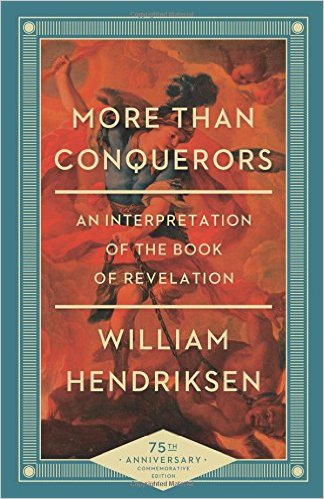
Symbols, not Riddles: A Review of William Hendriksen’s “More Than Conquerors”

more than conquerors

The son of Dutch immigrant parents, William Hendriksen (1900-1982) obtained his BA at Calvin College and went on to earn a doctorate from Princeton Seminary. In the early 1940’s, he was appointed Professor of New Testament at Calvin Theological Seminary, where he served for nine years before returning to full-time pastoral work. He is remembered both for his scholarly commentaries as well as for his 1939 book, More Than Conquerors: An Interpretation of the Book of Revelation.

In the 75th anniversary commemorative edition of More Than Conquerors, the included biographical tribute shares with readers that Hendriksen was a disciplined and prolific writer who could read in twenty(!) different languages and worked on his biblical commentaries even into his final years (p.8).

Written as the escalating rumbles of violence and warfare echoed ominously throughout Europe and the rest of the world, More Than Conquerors gives readers a clearly-written exploration of Revelation that seeks to show why Christians of John’s day found this apocalyptic work full of hope and comfort, rather than fear and confusion. Hendriksen explains:

The theme is the victory of Christ and of His Church over the dragon (Satan) and his helpers. The Apocalypse is meant to show us that things are not what they seem… Throughout the prophecies of this wonderful book Christ is pictured as the Victor, the Conqueror… He conquers death, Hades, the dragon, the beast, the false prophet, and the men who worship the beast. He is victorious; as a result, so are we, even when we seem to be hopelessly defeated. (pp.14-15)

Continue reading

Anathematize Them: A Review of David Wilhite’s The Gospel according to Heretics

gospel according to hereticsWhy should the Church ever listen to heretics? How do you define a heretic in the first place? In David Wilhite’s engaging and informative introduction to the early christological conflicts of the Church, The Gospel according to Heretics, he takes on these questions and more with admirable clarity, depth, and sensitivity. Wilhite teaches at George W. Truett Seminary in Texas and specializes in the study of North African Christianity in late antiquity, giving him a good background for taking readers into the world of the Patristic era.

In much traditional Christian thinking, heretics were viewed as evil and malicious (p.2). They were to be avoided and their voices were to be silenced if efforts to persuade ended in failure. The early church father Irenaeus, in his work Against Heresies, records that the Apostle John supposedly once fled from a building in order to avoid the heretic Corinth’s (3.3.4). Ignatius also exhorted readers in his Letter to the Trallians to, “cover up your ears in order to avoid receiving the things being sown by them” (9). Continue reading