The Summer Reading List: 2016 Edition

My days of letting out a long-awaited sigh of relief after having turned in the final paper of the semester are (for the time being) behind me. Now, summer really isn’t so different from any other time of the year. But I still love summer reading lists. As I said last year (in The 2015 Edition), it still makes my heart glad to see people around me (teachers, professors, students, and headmasters) “giddy with the prospect of reading time arriving thanks to the summer months.” Well, that’s still true. So let’s once again delve into this year’s list of books that I hope to read by the time autumn comes back around (and classes for those involved in such things). I truly intend to get through all these titles, but I’m also quite aware that my literary eyes are probably far too big for my stomach. Still, it will be fun to try.

Five New Voices

1. Francis Watson. He’s an English scholar who has devoted most of his career to New Testament studies and theological hermeneutics. Watson has taught at Durham University since 2007, and I’ve been wanting to read him for quite a while:

fourfold gospel

The Fourfold Gospel: A Theological Reading of the New Testament Portraits of Jesus. From the book’s description on Amazon: “Francis Watson, widely regarded as one of the foremost New Testament scholars of our time, explains that the four gospels were chosen to give a portrait of Jesus. He explores the significance of the fourfold gospel’s plural form for those who constructed it and for later Christian communities.” I recently finished Richard Hays’ excellent Echoes of Scripture in the Gospels, so I’m excited to listen to Watson’s perspective on the significance of the fourfold nature of the Gospels with Hays’ work in mind. Continue reading
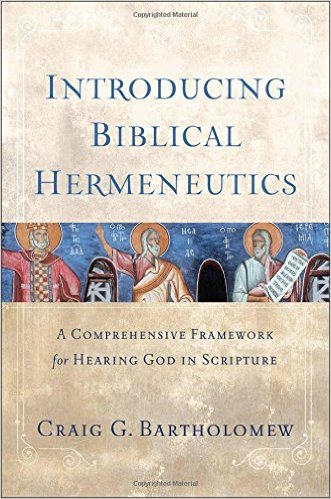
Attending to God’s Address: A Review of Craig Bartholomew’s “Introducing Biblical Hermeneutics”

introducing biblical hermeneuticsWhat should healthy biblical interpretation look like? Craig Bartholomew’s Introducing Biblical Hermeneutics addresses this question head on, giving a sweeping introduction to the subject that both explains the history and importance of various academic approaches while also developing for readers a vision of biblical hermeneutics that is trinitarian in shape and aimed ultimately at enabling “obedient attention to God’s address through his Word” (p.10). Bartholomew was born in South Africa in 1961 and now teaches at Redeemer University College in Ontario, Canada.

Hermeneutics deals with the study of interpretation, especially in regards to works of literature. Therefore, it’s a particularly relevant area of study for Christians given the uniquely authoritative role Scripture plays in shaping the beliefs and practices of the Church. Bartholomew invokes the words of Karl Barth to make clear the kinds of demands made by the Bible on its readers, “If Scripture is the Word of God, then, as Karl Barth rightly observes, no one can stand before it as a spectator” (p.45). Hermeneutics might seem intimidating and irrelevant, but Bartholomew argues that it actually is “the theory of a practice,” adding that when it’s done well, “hermeneutics deepens and enriches our practice of engagement with the Bible as Scripture” (p.12). Continue reading

The Parable of the Two Lost Sons: A Review of Tim Keller’s “The Prodigal God”

prodigal god*This post is by guest writer Ryan Parsons. He’s a longtime friend and great conversation partner. Ryan recently graduated from Appalachian State University with an M.A. in History and plans to begin seminary in the near future.

Celebrated pastor and author Tim Keller has identified a perplexing problem in the American Church, a particular discrepancy between belief and behavior. Churches do not appear to be drawing the same crowds that Jesus Himself drew. Keller argues in The Prodigal God: Recovering the Heart of the Christian Faith that churches are actually drawing flocks of people who resemble those who were most offended by Jesus’ message (pp.18-19). Even among lifelong churchgoers, there seems to be a lack of understanding as to how the gospel should shape everyday life (pp.xv-xvi). Keller takes pains to stress that “God’s reckless grace” should be “our greatest hope” and “a life-changing experience” (p.xx). How can a genuine experience and knowledge of God’s grace not change how we live?

Keller uses the Parable of the Prodigal Son as a platform to convey the gospel to both seekers and lifelong Christians, contending that “if the teaching of Jesus is likened to a lake, this famous Parable … would be one of the clearest spots where we can see all the way to the bottom” (pp.xvi-xvii). He argues that the traditional focus of the parable is wrong, given that both the younger brother and the elder brother represent “a different way to be alienated from God” (p.9). Perhaps we should instead think of it as the “Parable of the Two Lost Sons” (p.20). Before salvation, Keller suggests, each believer was either a younger brother or an elder brother; that we either tried to find happiness and fulfillment through self-discovery or moral conformity (p.34). In other words, we can rebel against God and be alienated from him either by breaking his rules or attempting to keep all of them diligently (p.42). Continue reading

Exploring the Old in the New: A Review of Stanley Porter’s “Sacred Tradition in the New Testament”

sacred traditionIn Sacred Tradition in the New Testament, Stanley Porter takes an extended look at the use of Israel’s Scriptures in the writings of the New Testament (NT). It’s clear that the Old Testament (OT) was crucially significant for the NT’s authors. But even if that’s agreed upon, and despite the spilling of much literal ink and the shedding of much metaphorical blood, legitimate questions remain. What led the writers of the NT to interpret the OT in the ways they did? How should we determine when a passage from the OT is being used in the NT, especially if the reference is indirect or subtle? These are the kinds of questions that Porter, a professor at McMaster Divinity College, seeks to explore.

Porter develops a number of proposals in Sacred Tradition in the New Testament. One of them is that the study of the OT’s use in the NT should shift away from the strict investigation of individual OT verses and onto broader themes, concepts and figures (p.49). In the introduction, he writes, “My approach to the use of sacred tradition tries to find more significant passages or themes within the OT and explore their use in the NT” (p.x). By sacred tradition, it should be noted that Porter basically means the OT, along with the Dead Sea Scrolls and some Hellenistic texts (p.3).

Before he begins tracing the NT development of OT themes and figures, though, Porter first attempts to bring greater methodological precision and clarity to the conversation (p.2).  Continue reading

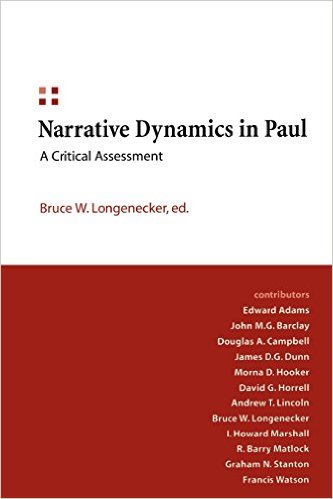
Do Paul’s Letters Have a Narrative Substructure? A Review of “Narrative Dynamics in Paul”

narrative dynamics in paulIn 1980, J.C. Beker declared in Paul the Apostle that, “Paul is a man of the proposition, the argument and the dialogue, not a man of the parable or story” (p.352). At the time, he was far from the only one who took that as an assumed position. A few short years after those words were written, though, the winds of change began to blow.

Over the last few decades, significant parts of Pauline scholarship have drawn enthusiastically from the field of literary theory, resulting in an increased amount of attention being given to the evocative ways in which Paul’s language engages with and alludes to earlier biblical narratives, among other things.  Continue reading

Slow and Steady Growth: A Review of Alan Kreider’s “The Patient Ferment of the Early Church”

patient ferment

On the first page of Alan Kreider’s new book, The Patient Ferment of the Early Church, he asks readers to pause and consider a sometimes overlooked question, “Why did this minor mystery religion from the eastern Mediterranean—marginal, despised, discriminated against—grow substantially, eventually supplanting the well-endowed, respectable cults that were so supported by the empire and aristocracy?”

Kreider, a Harvard-trained professor emeritus at Anabaptist Mennonite Biblical Seminary, has spent much his career studying early Christianity. In The Patient Ferment of the Early Church, he draws together this lifetime of work into a readable yet detailed study the early Church’s growth, looking especially at the period before Constantine’s reign (p.4). Continue reading

Studies in Galatians Episode III: Mariam J. Kamell on Reading Galatians and James Together

galatians and christian theologyIn this, the final post of our series looking at some of the essays in Galatians and Christian Theology, we are turning to Mariam Kamell’s, “Life in the Spirit and Life in Wisdom.” Kamell’s background is in the study of wisdom in the Epistle of James and in Jewish wisdom literature. She is currently a New Testament professor teaching out at Regent College in Vancouver, Canada.

The Apostles Paul and James were spiritual brothers in Christ. However, many get the impression that they must have been testy, quarrelsome siblings. Near the beginning of her piece, Kamell notes that, “There may be no two other epistles in the New Testament that have been so consistently contrasted to each other theologically as Galatians and James” (p.353). Martin Luther, in his typically blunt way, described James as someone who “wanted to guard against those who relied on faith without works, but was unequal to the task” (Word and Sacrament I). 

Kamell thinks that many Christians have been too quick to pit Paul and James against each other, spending too much time focusing either on their contentious relationship suggested by Galatians 2 (“certain men came from James”) or “on their different views of the law and Abraham in Galatians 3 and James 2” (p.354). One common way of reading them in light of each other has been to interpret James’s insistence that “faith by itself, if it has no works, is dead” (2:17 NRSV) as meaning that true faith in Christ leads to good works as a necessary consequence of being made a new creation in Christ. An example of this can be found in Reformed theologian Thomas Schreiner’s 2015 book, Faith Alone, where he asserts that “justification is by faith alone, but it is a faith that expresses itself in good works” (p.206).

Rather than strictly focusing directly on the faith vs. works issue in her essay, Kamell instead chooses to compare Paul’s treatment of life in the Spirit in Galatians 5-6 with James’s account of living according to wisdom.
Continue reading

Studies in Galatians Episode II: John Barclay on the Social Dimensions of God’s Gift in Christ

galatians and christian theology

Last time, we began our series of posts exploring Galatians and Christian Theology by looking at N.T. Wright’s colorful entry on the prominence of Jesus’ messiahship in Galatians. This time, we are turning a few pages farther on into the book and working through John Barclay’s “Grace and the Countercultural Reckoning of Worth.”

Barclay completed both his undergraduate and doctoral studies at Cambridge and has taught at Durham University since 2003. He’s received quite a bit of attention recently thanks to the long-awaited publication of his book, Paul and the Gift, a systematic and multi-faceted consideration of Paul’s theology of grace. So, maybe it’s timely that we can get a taste of Barclay’s overall project by paying attention to his perspective on the intersection of theology and ethics in Galatians.

While most interpreters have come to agree that the warnings, exhortations, and ethical guidelines given by Paul in Galatians 5-6 are in one way or another integral to the meaning of the letter as a whole, Barclay notes that there is no corresponding consensus regarding exactly how these chapters are related to the ones preceding them (p.306). Finding a satisfying way of dealing with this issue is complicated since “any reading of these verses depends on a reading of the rest of the letter—and vice versa” (p.307). His general approach is to give a fresh consideration of Galatians as a whole, focusing especially on the social implications of the unconditioned nature of God’s gift in Christ (which he often refers to as the “Christ-gift”). Continue reading

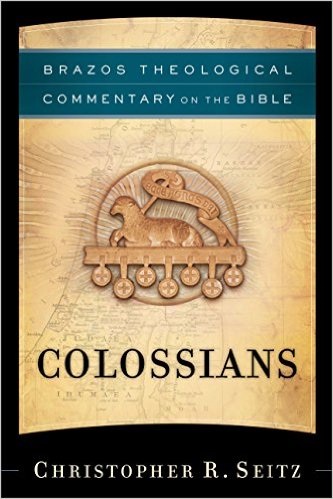
The Vocation of Letter Writing: Christopher Seitz’s Commentary on Colossians

colossiansIn his commentary on Colossians, Christopher Seitz, an Old Testament scholar by trade, makes use of a wide array of ancient and modern Christian interpreters to give an irenic, theologically rich, and textually sensitive reading of Paul’s letter. Seitz’s book is part of the Brazos Theological Commentary on the Bible series, which takes as its premise the idea that “the Nicene tradition, in all its diversity and controversy, provides the proper basis for the interpretation of the Bible as Christian scripture” and that “dogma clarifies rather than obscures” (p.11).

One of the more unique facets of Seitz’s commentary is his canonical approach. He seeks to interpret Colossians in light of both the larger Pauline corpus of which it is a part, as well as the rest of the Old and New Testaments. He acknowledges from the outset that “canonical readings” have come under fire in the past for being “either a genre mistake or a piety masking illegitimate (‘unhistorical’ in our present parlance) interpretation” (p.50). Consequently, Seitz takes time to respond to these criticisms by giving a more in-depth description of what he thinks the term entails: Continue reading

Meal, Word, and Prayer: A Review of Andrew B. McGowan’s “Ancient Christian Worship”

ancient christian worship

First, a slightly provocative—and hopefully not completely unsubstantiated—claim: It seems to me that Andrew McGowan’s Ancient Christian Worship explicitly tells a story and implicitly makes an argument. In each of his colorful and well-written chapters, McGowan takes people on a trek through the different ways in which ancient Christians worshiped. He introduces readers to influential theologians like Augustine, Origen, and John Chrysostom, sharing ample examples from their writings on worship. McGowan also incorporates archeological research and makes use of fascinating early Christian documents like the Didache and the Apostolic Tradition, which give glimpses of how these ancient communities lived out (or sought to live out) their worship practices.

In other words, McGowan intentionally brings together multiple streams of academic research on early Christian worship in order to tell a coherent introductory narrative of how these worship practices originated and developed, while avoiding the tempting pitfalls of over-simplification and excessive generalization. He’s realistic about what is known, unknown, and unfortunately lost to history regarding how these early believers lived. Continue reading